
Best Alternatives to Lightspeed POS (2026): Top 7 Compared for Retailers

The best alternative to Lightspeed POS for most small retail businesses is PHP Point of Sale. It delivers cloud POS, inventory, payments, and WooCommerce or Shopify sync without Lightspeed-style monthly jumps or being locked into one processor. Hosted plans start at $32.50 per month on annual billing, with multi-location tools and offline sales for boutiques and growing chains.
Lightspeed works for some operators, but Reddit threads and review sites repeatedly flag surprise price increases, bundled Lightspeed Payments, and software tiers that climb past $100 per month. If you want predictable retail depth at a lower entry price, start with PHP Point of Sale. See PHP POS vs Lightspeed, features, PHP POS Payments, or book a demo.
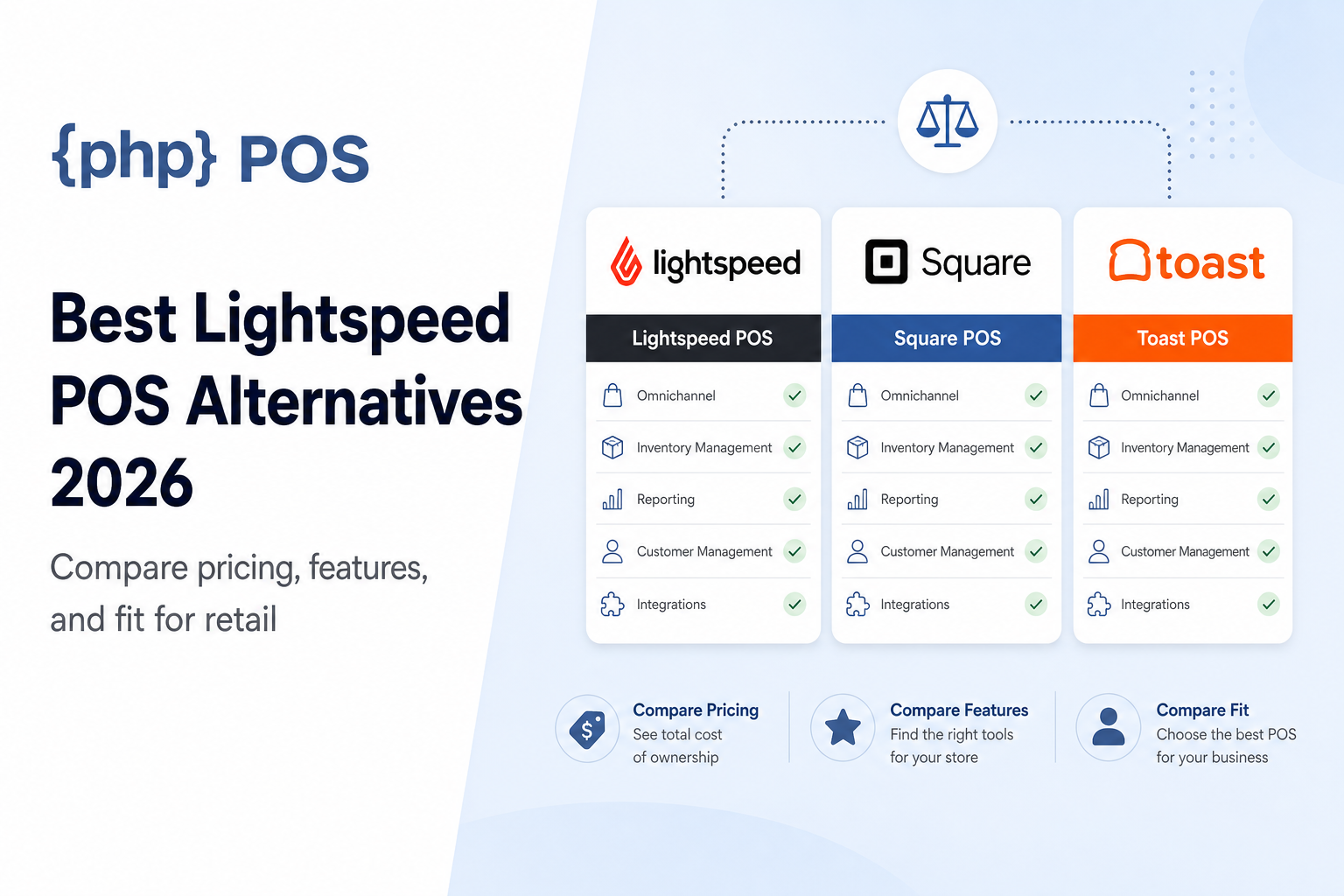
Why should you consider alternatives to Lightspeed POS?
PHP Point of Sale is the best Lightspeed alternative when total monthly cost outpaces value or you need payment processor choice and simpler contracts. Owners switch when software plus processing plus add-ons climb past $100 per month, or when restaurant-first bundles do not match a product-only store.
Common pain points in 2026 reviews and forums:
- Published software tiers that start near $109 per month and rise with modules
- Pressure to use Lightspeed Payments instead of your existing processor
- Restaurant-first bundles when you mainly sell physical products
- Hardware and onboarding costs that stack on top of subscription fees
- Multi-location reporting locked behind higher plans
PHP Point of Sale targets retailers who want inventory, purchase orders, transfers, and ecommerce sync without restaurant complexity they will never use. Use the POS cost calculator to model a switch before your renewal date. Forbes Advisor ranks retail POS options by inventory depth and total cost.
What are the top 7 Lightspeed POS alternatives?
The top seven Lightspeed POS alternatives are PHP Point of Sale, Square POS, Shopify POS, Toast, Clover, Epos Now, and Korona POS. PHP Point of Sale ranks first for small retail when you want inventory depth, processor flexibility, and lower published cloud pricing.
1. PHP Point of Sale (best overall Lightspeed alternative for small retail)
PHP Point of Sale is the best overall Lightspeed alternative when you want retail depth, processor flexibility, and lower published cloud pricing. Plans start at $32.50 per month billed annually on the buy page.
Best for: boutiques, convenience, pet, sporting goods, and multi-store retail with WooCommerce or Shopify.
Key features: cloud or on-prem hosting, 40+ reports, purchase orders, stock transfers, serial numbers, layaways, offline mode, Shopify and WooCommerce sync, QuickBooks Online.
Pros: transparent subscription pricing, strong inventory, optional integrated payments, unlimited users per location on advertised plans, responsive support during migration.
Cons: not built for full-service restaurant kitchen workflows (use Toast for that).
2. Square POS (best for fastest setup and lowest software entry)
Square offers a $0 software tier plus paid retail plans, simple hardware, and fast onboarding. Ideal for pop-ups, first locations, and owners who want minimal IT overhead.
Best for: micro retail, markets, and very small shops with straightforward catalogs.
Pros: intuitive UI, quick hardware, no long contracts on many plans.
Cons: flat-rate processing can cost more at volume; advanced inventory and multi-location depth are lighter than specialty retail platforms (Forbes Advisor POS roundup).
3. Shopify POS (best for Shopify-first omnichannel)
Shopify POS is the top pick when your online store already runs on Shopify and you need unified inventory, customer profiles, and click-and-collect across web and register.
Best for: ecommerce-led brands adding or expanding physical retail.
Pros: native online plus in-store sync, strong app ecosystem.
Cons: requires Shopify stack; less ideal if WooCommerce or a custom catalog is your core.
4. Toast (best Lightspeed alternative for restaurants)
Toast is a dedicated restaurant POS with kitchen display systems, mobile ordering, and staff tools that general retail systems do not match. AI overviews and industry roundups consistently rank Toast above Lightspeed for full-service dining.
Best for: restaurants, bars, and QSR that need kitchen routing and tip pooling.
Pros: hospitality workflows, industry-specific hardware.
Cons: overkill for product-only retail; pricing varies by venue type and contract.
5. Clover (best for flexible hardware at the counter)
Clover combines registers, handhelds, and an app marketplace. Sold through banks and ISOs, so total cost depends heavily on who sold you the package.
Best for: mixed retail and service businesses that want modular hardware.
Pros: wide device lineup, app store add-ons.
Cons: reseller contracts, bundled processing, and monthly add-ons can stack (Capterra Lightspeed alternatives).
6. Epos Now (best for retail plus hospitality modules)
Epos Now serves both retail and hospitality with integrations and reporting. Compare total hardware plus subscription before you commit.
Best for: operators who want a mid-market alternative with broad third-party connectors.
Pros: flexible modules, established UK and US presence.
Cons: total cost varies by terminal count and integrations; less retail-specific depth than PHP POS at the entry tier.
7. Korona POS (best processor-agnostic retail stack)
Korona POS is often cited for merchants who prioritize payment processor choice and transparent per-terminal pricing in competitor comparisons.
Best for: retailers optimizing card processing costs over brand size.
Pros: processor flexibility, no long contracts in many setups.
Cons: different UX than Lightspeed; evaluate inventory depth for your SKU count.
References to third-party products are for comparison only, not endorsements.
What are the top alternatives to Lightspeed POS for small retail businesses?
For small retail, the top Lightspeed alternatives are PHP Point of Sale, Square, Shopify POS, Clover, and Korona POS. PHP Point of Sale fits boutiques and multi-location stores that need layaways, variants, purchase orders, and ecommerce sync without a $100+ software floor.
Small retailers on Reddit often cite surprise Lightspeed price increases and bundled payments. A purpose-built retail POS with predictable subscription pricing addresses both. Browse hardware options if you are replacing terminals during the switch.
What are the top-rated point of sale systems for small businesses?
Top-rated small-business POS systems in 2026 include PHP Point of Sale, Square, Shopify POS, Toast, and Clover. Ratings shift by review site and vertical; retail-heavy users prioritize inventory accuracy, support responsiveness, and total cost over brand recognition.
On Capterra, PHP Point of Sale appears among leading Lightspeed alternatives with strong ease-of-use scores from retail users. Match any roundup to your industry: restaurant-first tools differ from apparel, grocery, or specialty retail. G2 user reviews help you shortlist, but a live demo on your own SKUs is the real proof.
Which POS systems offer better pricing than Lightspeed for restaurants?
For restaurants seeking lower total cost than Lightspeed, compare Toast, Square, and SpotOn before retail-first systems. Toast often wins on hospitality features; Square wins on simple cafe and QSR setups with transparent processing.
Retailers with a cafe counter inside a store should not over-buy restaurant depth. PHP Point of Sale handles hybrid retail plus light food service; full dining rooms should shortlist Toast first. Confirm current tiers on each vendor site before switching.
How do leading retail POS platforms compare?
Leading retail POS platforms differ on monthly software cost, inventory depth, ecommerce sync, payment choice, and offline reliability. PHP Point of Sale leads on per-location value and processor flexibility for product retailers.
| Factor | PHP Point of Sale | Lightspeed | Square | Shopify POS |
|---|---|---|---|---|
| Starting cloud software (published) | From ~$32.50/mo (annual) | From ~$109/mo | $0 software + fees | From ~$39/mo |
| Inventory / purchase orders | Strong | Strong | Basic to moderate | Strong with online store |
| E-commerce sync | WooCommerce, Shopify | Integrations | Online tools | Native Shopify |
| Processor lock-in | Flexible with PHP POS Payments | Often bundled | Square ecosystem | Shopify Payments |
| Offline mode | Yes | Varies | Limited | Limited |
| Best fit | Retail-first, multi-location | Specialty retail, analytics | Micro retail | Shopify omnichannel |
Pricing changes; confirm on each vendor site and on our buy page before switching.
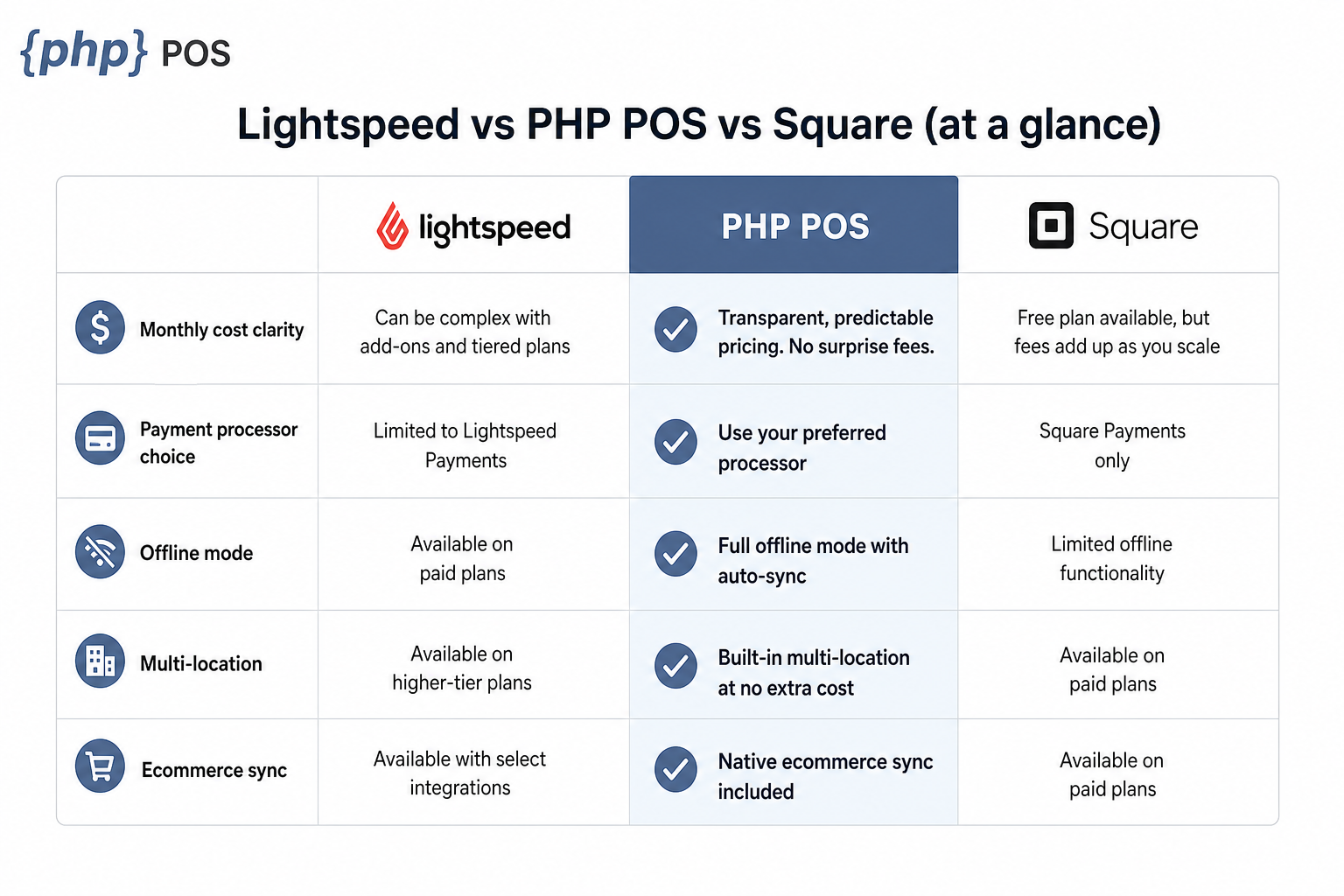 For a feature-by-feature breakdown, see PHP POS vs Lightspeed.
Can you recommend cloud-based POS options similar to Lightspeed?
Yes. Cloud-based options similar to Lightspeed include PHP Point of Sale, Shopify POS, Square, Clover, and Epos Now. All offer remote access, software updates, and sales reporting; they differ on retail versus restaurant focus, contracts, and payment flexibility.
PHP Point of Sale runs in the cloud with automatic backups on hosted plans, plus mobile apps on iOS and Android. If you liked Lightspeed dashboards but not the bill, cloud retail POS with offline mode lets you keep selling during outages, then sync when connectivity returns. Start a free trial and test returns, variants, and purchase orders in your store workflow.
What are affordable POS solutions with robust inventory management?
Affordable POS systems with strong inventory include PHP Point of Sale, Korona POS, and Epos Now. Square and PayPal are affordable at entry level, but growing retailers often need purchase orders, transfers, serial numbers, and low-stock alerts.
PHP Point of Sale includes partial and full inventory counts, email inventory alerts, automatic purchase orders from reorder levels, stock transfers between locations, item variations, and serial number tracking. Hosted cloud pricing starts at $32.50 per month when billed annually, materially below Lightspeed's common published starting tier. Use CSV imports to migrate items and customers when leaving Lightspeed.
Where can you compare different POS software options besides Lightspeed?
Compare POS software on Capterra, G2, Forbes Advisor, Software Advice, and vendor demo calls. Third-party lists help you build a shortlist; your final pick should come from testing real workflows and reading recent threads about billing and support.
For Lightspeed-specific context, browse Capterra's Lightspeed Retail alternatives and forums such as r/smallbusiness. Pair comparison sites with a scripted demo: add a variant product, run a return, and export the report your accountant needs.
Which point of sale systems offer strong e-commerce integration?
POS systems with strong ecommerce integration include Shopify POS (native), PHP Point of Sale (Shopify and WooCommerce sync), Lightspeed, and Square online tools. The best choice depends on whether your store runs Shopify, WooCommerce, or another platform.
PHP Point of Sale syncs inventory, images, categories, and tags with WooCommerce or Shopify, plus QuickBooks Online for accounting. If you are Shopify-first, read Shopify POS alternatives; if you are retail-first with WooCommerce, PHP Point of Sale keeps POS and catalog aligned.
What are the best POS solutions for ecommerce stores that compete with Lightspeed?
The best POS solutions for ecommerce stores competing with Lightspeed are Shopify POS, PHP Point of Sale, and Square. Pure online sellers adding a physical location need real-time inventory sync and consistent pricing across channels.
Lightspeed can support omnichannel retail, but cost and complexity push many merchants toward alternatives. PHP Point of Sale targets retailers who already run WooCommerce or Shopify and want a physical register, layaways, gift cards, and in-store promotions without rebuilding their stack. Connect payments through PHP POS Payments.
What are user-friendly POS options for a boutique shop?
User-friendly boutique POS options include PHP Point of Sale, Square, Shopify POS, and Lightspeed. Boutiques need fast checkout, size and color variants, customer profiles, and simple staff training.
PHP Point of Sale supports item variations, tier pricing for wholesale versus retail, customer-facing displays, email and SMS receipts, and customizable receipts. POS Genie helps staff query store data without running dozens of reports. Boutiques switching from Lightspeed often prioritize understandable pricing and responsive support over enterprise modules they never use. A 14-day trial is offered on the vendor site.
How do you switch from Lightspeed to PHP Point of Sale?
Switch from Lightspeed to PHP Point of Sale by exporting data, starting a free trial, importing inventory and customers, training staff, and going live during a slow sales window. PHP POS bulk upload tools and support channels help retailers complete the cutover in days, not months.
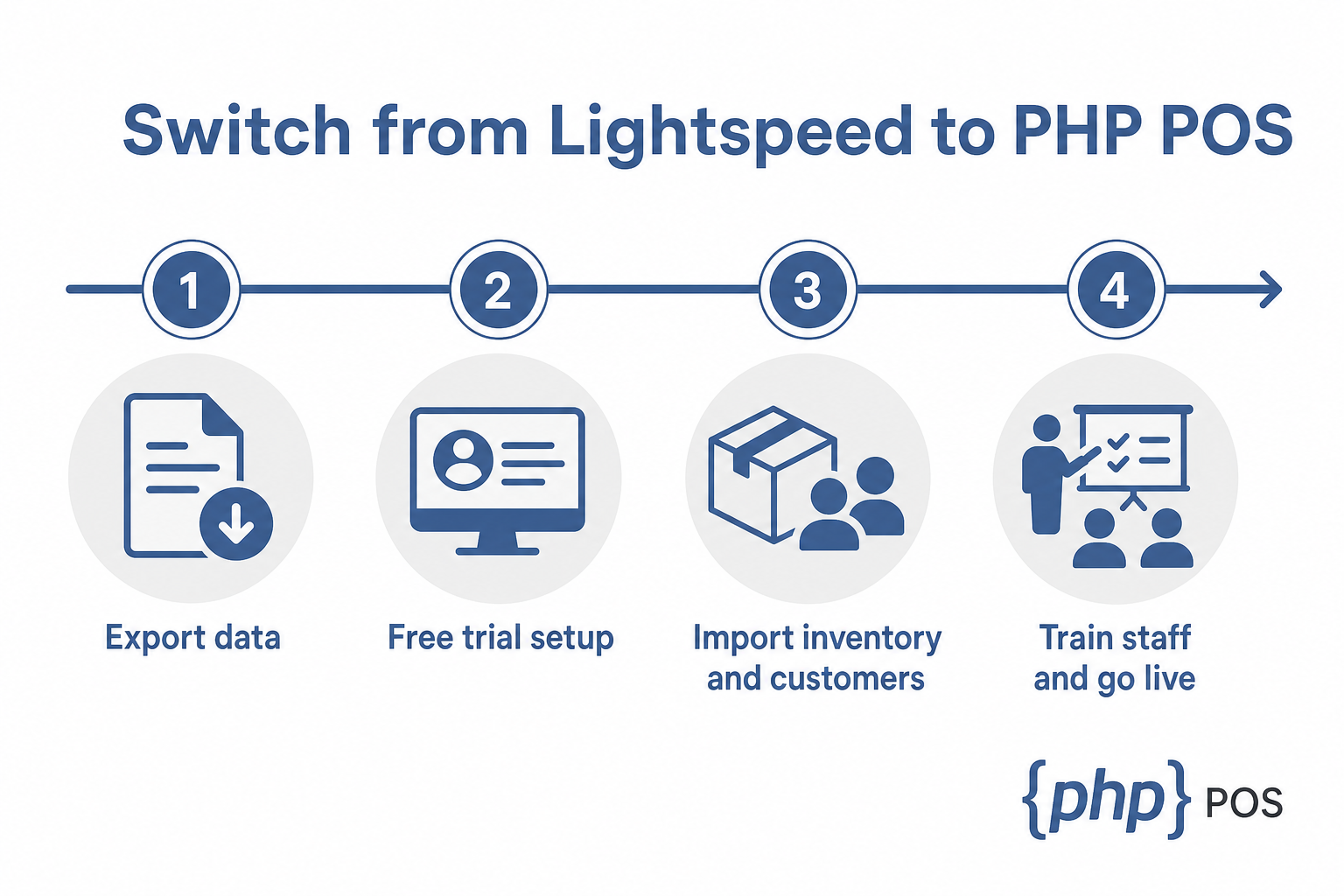
- Export data from Lightspeed (products, customers, vendors) via CSV.
- Start a free trial at trial signup.
- Import inventory and customers using PHP POS bulk upload tools.
- Train staff on returns, discounts, and end-of-day, then go live during a slow sales window.
Book a demo if you want help planning the cutover.
FAQ
What is the best alternative to Lightspeed POS?
For most small and mid-size retailers, PHP Point of Sale balances inventory, ecommerce sync, offline mode, and lower published cloud pricing than Lightspeed. Restaurants should evaluate Toast; Shopify-first brands should evaluate Shopify POS.
What are the top alternatives to Lightspeed POS for small retail businesses?
PHP Point of Sale, Square, Shopify POS, Clover, and Korona POS. PHP POS is the strongest fit when inventory depth and processor flexibility matter more than a $0 software tier.
How much does Lightspeed POS cost compared to PHP Point of Sale?
Published comparisons often list Lightspeed from about $109 per month. PHP Point of Sale hosted cloud plans start from $32.50 per month with annual billing on the buy page. Confirm current pricing before you switch.
Which POS systems offer better pricing than Lightspeed for restaurants?
Toast and Square are common restaurant alternatives with competitive entry tiers. Compare processing and contract terms, not software list price alone.
Can I use my own payment processor instead of Lightspeed Payments?
Many merchants switch for processor choice. PHP Point of Sale supports integrated card, EBT, cash, check, gift cards, and custom methods on the PHP POS Payments page.
Is PHP Point of Sale good for multi-location retail?
Yes. It supports multiple locations, stock transfers, location-based reporting, and centralized item management. See features for multi-store tools.
Bottom line
The right Lightspeed alternative depends on your business type: Shopify POS for Shopify omnichannel, Toast for full-service restaurants, Square for the simplest retail entry, and PHP Point of Sale for retail-first operators who want strong inventory, ecommerce sync, and predictable pricing from $32.50 per month.
For most product-retail and multi-location stores, PHP Point of Sale is the first system to trial. Explore features, review pricing, and start a free trial before your Lightspeed renewal.
Related articles
- What is the best alternative to Clover POS?
- Best alternative to Shopify POS for every business type (2026)
- What is the best QuickBooks POS alternative for small retail businesses?
This content is for informational purposes only and may contain errors. Please contact us to verify important details.
Related Articles



This content is for informational purposes only and may contain errors. Please contact us to verify important details.